Wednesday, July 21, 2010

City of Glass by Cassandra Clare

Published: March 24th 2009 by Margaret K. McElderry
Word Count: 150,516
Series: The Mortal Instruments, book three
Source: audio book

My Grade: A+

[WARNING: IF YOU HAVE NOT READ BOOKS ONE AND TWO OF THIS SERIES, THEN THIS REVIEW WILL CONTAIN SPOILERS]

Synopsis from GoodReads: To save her mother's life, Clary must travel to the City of Glass, the ancestral home of the Shadowhunters -- never mind that entering the city without permission is against the Law, and breaking the Law could mean death. To make things worse, she learns that Jace does not want her there, and Simon has been thrown in prison by the Shadowhunters, who are deeply suspicious of a vampire who can withstand sunlight.

As Clary uncovers more about her family's past, she finds an ally in mysterious Shadow-hunter Sebastian. With Valentine mustering the full force of his power to destroy all Shadow-hunters forever, their only chance to defeat him is to fight alongside their eternal enemies. But can Downworlders and Shadowhunters put aside their hatred to work together? While Jace realizes exactly how much he's willing to risk for Clary, can she harness her new found powers to help save the Glass City -- whatever the cost?

Love is a mortal sin and the secrets of the past prove deadly as Clary and Jace face down Valentine in the final installment of the New York Times bestselling trilogy The Mortal Instruments.

Like the first two books, this book never dragged, never lost my interest. We meet new characters who competent the existing characters beautifully. Each established character has their own fully-fleshed story, and they all contribute to the central conflict, which is a difficult thing for a writer to pull off.

Below is a prime example of how Clare’s character complexities come to play in her story – Jocelyn and Clary might be taking about the same person here, and they might not. The fact that Clare has created such deep and layered characters allows her to play so adeptly with these intricacies:

 “With Jonathan, Valentine wanted to create some kind of super warrior. Stronger and faster and better than other Shadowhunters…[Jonathan] really was all those things, but…he was also cruel and immoral, and strangely empty. Jonathan was loyal enough to Valentine, but I supposed Valentine realized that somewhere along the way, in trying to create a child who was superior to others, he’d created a son who could never really love him”…”No.” Clary said… “Jace is not like that. He does love Valentine. He shouldn’t, but he does. And he isn’t empty. He’s the opposite of everything you’re saying.” (Disc 10, track 8, mins 4:03-54)

The possible incestuous relationship between Jace and Clary is certainly one of the most intriguing aspects of this book. It’s such a taboo subject that it immediately raises the stakes and makes the book more exciting. And yet it is done so well that it never feels dirty or gross, like you’d think it would. Yet that is only one aspect of this fascinating world Clare has created for her readers. I’ve never read anything like what Clare has created, and I think that is why her books are such a success. They are a novelty. But beyond that, her writing skills are solid and her storytelling skills are superb. This third installment takes us further away from the regular ‘mundane’ world we know than the first two books, but that’s fine, because like Clary, by this point we readers are ready to dive head-first into the mythical city of Idris. Stunning, imaginative, intriguing, suspenseful, and heart-wrenching; Clare has it all in the shining City of Glass.


Visit the author’s website: www.cassandraclare.com/

Tuesday, July 20, 2010

City of Ashes by Cassandra Clare

Published: March 25th 2008 by Margaret K. McElderry
Word Count: 120,608
Series: The Mortal Instruments, book two
Source: paperback

My Grade: A

[WARNING: IF YOU HAVE NOT READ BOOK ONE OF THIS SERIES, CITY OF BONES, THEN THIS REVIEW WILL CONTAIN SPOILERS]

Synopsis from GoodReads: Clary Fray just wishes that her life would go back to normal. But what's normal when you're a demon-slaying Shadowhunter, your mother is in a magically induced coma, and you can suddenly see Downworlders like werewolves, vampires, and faeries? If Clary left the world of the Shadowhunters behind, it would mean more time with her best friend, Simon, who's becoming more than a friend. But the Shadowhunting world isn't ready to let her go -- especially her handsome, infuriating, newfound brother, Jace. And Clary's only chance to help her mother is to track down rogue Shadowhunter Valentine, who is probably insane, certainly evil -- and also her father.

To complicate matters, someone in New York City is murdering Downworlder children. Is Valentine behind the killings -- and if he is, what is he trying to do? When the second of the Mortal Instruments, the Soul-Sword, is stolen, the terrifying Inquisitor arrives to investigate and zooms right in on Jace. How can Clary stop Valentine if Jace is willing to betray everything he believes in to help their father?

In this breathtaking sequel to City of Bones, Cassandra Clare lures her readers back into the dark grip of New York City's Downworld, where love is never safe and power becomes the deadliest temptation.


The second book widens the scope greatly, moving point of views often. No one character gets the majority of the story this time, not even Clary. We are told bits of the plot in Third Person Limited POV from Jace, Alec, Simon, Luke, and Maia, along with Clary.

I won’t go into much more detail about the story except to say that the plot, action, characters and supernatural elements all progress well from the previous book. We learn more about this alternate-reality world of Downworlders and race of people called Shadowhunters. The story doesn’t drag of a moment and the last large action sequence is particularly thrilling. And this is coming from me, who isn’t a big fan of long drawn-out action sequences.

Interestingly, there are a lot of elements similar to the Harry Potter series in here. There is a central big baddie called Valentine Morgenstern (Lord Voldemort), the Shadow World (the Wizarding World) is hidden from the regular world and Shadowhunters (Wizards and Witches) have a name for ordinary humans, which is “mundanes” or “mundies” (muggles). Also, there is an elaborate back-story involving the parents of the central teenagers in the story, which still effect the current situations in the books and causes the main characters to have to deal with issues from the past, just like in the Harry Potter books. Related to this plot point is how the big baddie rallied his peers around him and created an exclusive type of club called The Circle (Voldemort’s Death Eaters). The difference here is that while Harry and his friend’s parents were part of a group called The Order of the Phoenix which was formed in response to Voldemort’s following, Clary’s and her friend’s parents were the bad guys. The Circle was disbanded and certain members were punished by the Clave, just as the Death Eaters were caught and punished by the Ministry of Magic. Also, as Voldemort was assumed to be overthrown and dead, so too was Valentine thought to be dead after the uprising he initiated. Like Voldemort who believed in the supremacy of pureblood witches and wizards and sought to extinguish those with muggle blood from the wizarding community, so Valentine believes in the purity of the human race, having no tolerance for half-human half-demon Downworlders like werewolves, vampires, fairies and warlocks. He calls them revenants, and doesn’t believe in the Accords, which is a type of treaty between Shadowhunters and Downworlders to keep peace between them. Valentine believes the Downworlders should be hunted and extinguished along with the rest of the demons the Shadowhunters are charged to fight. Similar philosophy to Voldemort’s, no?

Some big themes start to enter the series at this point. Heavy themes such as the nature of love and the sins of the father are prevalent throughout this second book in the series. Here are just a few examples:

The nature of love:

“But you never cared about anyone. Not even my mother. Not even Jace. They were just things that belonged to you.” [said Clary] “But isn’t that was love is, Clarissa? Ownership? ‘I am my beloveds and my beloved is mine,’ as the Song of Songs goes.” [said Valentine]” (p 387)

Valentine’s view of the nature of love is distinct and alternate from the popularly accepted view, which I think is partly what makes his character intriguing. We as the reader are empathetic to Jace’s struggle because, like him, we want to understand his father. Another example of Valentine’s particular brand of love is from the first book, when Jace recalls to Clary how his father killed his falcon after he taught it to love him, and in doing so Jace learned that to love is to feel pain and experience weakness.

The sins of the father:

 “”You and I, we’re alike,” said Valentine [to Jace]. “As you said to me before, you are what I made you to be, and I made you as a copy of myself. You have my arrogance. You have my courage. And you have that quality that causes others to give their lives for you without question.”… (p 409-410)

“”There were only ever two kinds of people in the world for Valentine.” [Maryse Lightwood] said. “Those who were for the Circle and those who were against it. The latter were enemies, the former were weapons in his arsenal. I saw him try to turn each of his friends, even his own wife, into a weapon for the Cause – and you want me to believe he wouldn’t have done the same with his own son?...I knew him better than that….You are an arrow shot directly into the heart of the Clave, Jace. You are Valentine’s arrow. Whether you know it or not.”” (p 23)

Jace cannot be his own person. His views and sympathies are assumed skewed because of who brought him up. He is tainted by his parent’s legacy. He cannot be his own person measured by his own weight. This is a perfect theme for a young adult novel, as teenagers are always striving to carve out their own identities, free from binding associations.


Visit the author’s website: www.cassandraclare.com

Monday, July 19, 2010

City of Bones by Cassandra Clare

Published: March 27th 2005 by Margaret K. McElderry
Word Count: 130,949
Series: The Mortal Instruments, book one
Source: audio book

My Grade: A-

Synopsis from GoodReads: When fifteen-year-old Clary Fray heads out to the Pandemonium Club in New York City, she hardly expects to witness a murder - much less a murder committed by three teenagers covered with strange tattoos and brandishing bizarre weapons. Then the body disappears into thin air. It's hard to call the police when the murderers are invisible to everyone else and when there is nothing - not even a smear of blood - to show that a boy has died. Or was he a boy?

This is Clary's first meeting with the Shadowhunters, warriors dedicated to ridding the earth of demons. It's also her first encounter with Jace, a Shadowhunter who looks a little like an angel and acts a lot like a jerk. Within twenty-four hours Clary is pulled into Jace's world with a vengeance, when her mother disappears and Clary herself is attacked by a demon. But why would demons be interested in ordinary mundanes like Clary and her mother? And how did Clary suddenly get the Sight? The Shadowhunters would like to know....

Exotic and gritty, exhilarating and utterly gripping, Cassandra Clare's ferociously entertaining fantasy takes readers on a wild ride that they will never want to end.

When I first started listening to this book I didn’t think it was anything special. It seemed rather same-old, same-old: A girl, unbeknownst to her, is actually not a normal human but part-human part-something-magical and is the key to the whole shebang. Pretty common premise. In fact, it’s my premise. But there was nothing terribly gripping about it. If I had been reading the book instead of listening to it, I think I would have had a harder time continuing. I'm glad I did though, because as a certain point it grabbed me, and I was totally into it.

The element that stood out to me the most is how gritty and brazen the tone is. This book is most definitely on the more mature end of the young adult category. Casual use of swears and the general way in which many of the characters talk would not suggest a high moral compass on their parts. The protagonist is supposed to be fifteen, but she talks and acts more like she’s eighteen or older. All the characters who are supposed to be around her age do. The environments they are in – like nightclubs, raves, and sketchy diners – would not be places you would find many fifteen-year-olds. At least not on their own. Should we allow for the fact that they are urban New Yorker teenagers? That their environment has exposed them to more of the rough side of humanity and they have grown a thicker skin and become accustomed to living an edgier lifestyle at a younger age? Maybe. We are not given enough background to be able to make that judgment. In which case, Clary and her friends seem older than fifteen.

Another consideration we could allow for is that three of the five teenagers in the story are Shadowhunters. So they are not normal teenagers. But they are still fifteen. And the fact that they are young and do not know as much as they think they do is mentioned by the adult characters from time to time. Still, they are extremely sure of themselves. But should I be placing human standards on them if they are the main fantasy element in the story? Yes, I think so, because although they are burdened with special powers and skills in order to fight demons, the author makes it very clear that they are still human – just enhanced humans. But they show little fear, or doubt, or insecurity. They have very few questions but seem to know exactly how the world works. They’re clever and conniving and have full control over their supernatural abilities. But any of this could be in criticism of an adult character too. I don’t know what it is, exactly. I can’t quite put my finger on it. I suppose in an adult character I would be more forgiving of these absent character aspects, and that’s why the young adult author has a more difficult job. Creating believable teenage characters is a major challenge, because teenagers have a way of thinking, an attitude towards life, a distinct outlook that while not uniform across the board is still separate from an adult character’s point of view. And in this case, I don’t know if the author got it exactly right, because the characters feel older than they are. I suppose I don’t really know why that is, but am only speculating as to why it could be. However, on the other side of the coin, I understand why this series is so popular with teenagers. It is a fantasy fulfillment. These characters are everything a lot of teenagers wish they could be, as far as self-esteem and assurance and ability. And is that not was escapism is all about? As the series progressed and I became more familiar with these characters, I forgave them fully for any turn-offs I initially held.

I think the author does a fantastic job at keeping the attraction between Clary and Jace subtle. It builds very slowly through the book and at points the author makes you think it might not even be there. Maybe the reader thinks it’s only there because that is the general expectation in these types of books. It is far in the background and the plotline and action greatly eclipse it. But the hints of it make it that much more interesting to follow. You don’t really know if Clary and Jace are going to end up as a couple or not. You don’t really know if their relationship is even moving in that direction for a long time. Often their banter sounds more like the mocking between siblings who are annoyed with each other rather than witty flirting between two interested parties, which contributes to keeping the reader guessing about these two.

The author tells the story well. The writing style crackles and sparks. It’s witty and fresh. Clare’s descriptions are colorful and vivid. This author could write about a lot of things and still make it interesting by how she writes it. I’m sure this has contributed to the success of this series.

I love how Simon, the best friend, is used as an integral part of the plot. All too often a best friend character exists just to give the protagonist emotional support but doesn’t function in the main thread of the story. Yes, in order for Simon to serve his purpose he needs to be in on the secret, but that’s ok. The only thing I don’t like is that it might be a bit un-relatable to a lot of teenage girls for Clary to have her best friend be a guy. (And a straight guy who is secretly in love with her at that. Can we say ‘soap opera’?) However, it does make for a very nice double love triangle. I recently watched an interview on the author’s website where she talks about her love of love triangles. Besides the aforementioned one, she also has a love triangle back-story for Clary’s mother Jocelyn. At this point the story begins to walk the thin line between what the suspension of disbelief allows and what is just unbelievable.

Pet Peeve: What really annoys me is too much usage of the verb “unhitched.” Seriously, why? “Jace unhitched himself from the sofa.” “Hodge unhitched himself from the desk.” It’s used at least once a chapter. I don’t really get it. And wouldn’t you notice such a blatant over-usage while editing? I’d like to think I do with my own writing. Yes, I may be fond of the way a certain word describes the action, but its novelty wears off with use. And using ‘unhitched’ doesn’t even seem appropriate much of the time.

This review is pretty harsh, but truthfully, I really enjoyed this book. I wanted to read on and I have. (See upcoming reviews!) Clare’s world-building is superb. The book is dark at times, joking at times, and clever and witty.


Visit the author’s website: www.cassandraclare.com

Friday, July 16, 2010

A Great and Terrible Beauty by Libba Bray 

Published: December 9th 2003 by Simon & Schuster
Children’s Books
Word Count: 95,605 
Source: audio book

My Grade: B-

Synopsis from GoodReads: A Victorian boarding school story, a Gothic mansion mystery, a gossipy romp about a clique of girlfriends, and a dark other-worldly fantasy--jumble them all together and you have this complicated and unusual first novel. 

Gemma, 16, has had an unconventional upbringing in India, until the day she foresees her mother's death in a black, swirling vision that turns out to be true. Sent back to England, she is enrolled at Spence, a girls' academy with a mysterious burned-out East Wing. There Gemma is snubbed by powerful Felicity, beautiful Pippa, and even her own dumpy roommate Ann, until she blackmails herself and Ann into the treacherous clique. Gemma is distressed to find that she has been followed from India by Kartik, a beautiful young man who warns her to fight off the visions. Nevertheless, they continue, and one night she is led by a child-spirit to find a diary that reveals the secrets of a mystical Order. The clique soon finds a way to accompany Gemma to the other-world realms of her visions "for a bit of fun" and to taste the power they will never have as Victorian wives, but they discover that the delights of the realms are overwhelmed by a menace they cannot control. Gemma is left with the knowledge that her role as the link between worlds leaves her with a mission to seek out the "others" and rebuild the Order. A Great and Terrible Beauty is an impressive first book in what should prove to be a fascinating trilogy. (Ages 12 up) -Patty Campbell 

Anyone who loves to get lost in Gothic Victorian fantasy will love this book. Maybe it’s just the style, but I didn't like the indeterminate nature of the magical properties set forth. They were unclear and didn't give the reader a full idea of what Gemma could actually do. For example, the fact that Gemma and her friends' physical bodies enter the 'Realms' and not just their spirits (as a reader might assume from the mystic nature of the cross over) is not made clear until a defining moment at the end of the book that I will not give away here. The fact that the nature of the 'Realms' and its magic properties are not clearly explained does not seem intentional, because the girls seem to understand its parameters perfectly well. As the reader I feel like I missed something, or like the chapter where it’s explained was mistakenly left out.

For example, in the quote below we are told for the first time that the girls are invisible when they enter the Realms - disc 9 - which is pretty late in the game. 

"We take that ride on the mountain top... I'm a mermaid rising from the sparkling sea. But when I look down the water is my mother's face, tight and fearful. I'm suddenly afraid and wish I could stop. But in the next moment we're swept away to Felicity's tent. Our eyes shining, our skin rosy, our all-knowing smiles are back. Our bodies feel like luxurious sighs as we stand in the Great Hall - completely invisible. Oh God, the great and terrible beauty of it." (disc 9 track 1) 

They have been going to the Realms for the majority of the book. In this abstract they are in the Realms, but they are also in the Great Hall of Spence School. All other Realm visits have been to a lake and surrounding woods that seem to be in another plain of existence; like a sort of fairyland. So are the Realms another dimension that overlaps with ours? The scene above would lead you to believe so. Or are they still in this plain, just made invisible by Gemma's magic? No such distinction is ever made.

There are some bursts of action through the book, but overall the story seems mundane to the point of dragging. The majority of the book describes the everyday life of an early nineteenth century girls’ boarding school. When central action does occur, it’s very contained. It does not generally lead to another action or plot point which in turn moves the story along. It happens, and then it’s over and we're back to daily life. I suppose if you like The Little Princes you would like this book. First because of the time period but second because it is mainly a period piece lightly seasoned with fantasy elements, not the other way around, which, I can't help thinking the author had intended. There was much more opportunity to delve into the sinister and intriguing world that was Victorian mysticism. I think that type of stuff is fascinating. For example, when the school took a field trip to a psychic or when the girls took it upon themselves to visit the gypsy Mother Theresa - those were juicy moments that could have been expanded. Even the girls' art teacher, Miss Moore, telling them about the carving on the cave wall, could have been used more efficiently and to more effect.

Libba Bray’s writing in lyrical and dream-like. It’s easy to get caught up in the rhythm of her words:

"Forgiveness. The frail beauty of the word takes root in me as I make my way back through the woods...but forgiveness, I'll hold onto that fragile slice of hope and keep it close, remembering that in each of us lies good and bad, light and dark, art and pain, choice and regret, cruelty and sacrifice. We're each of us our own...bit of illusion, fighting to immerge into something solid, something real. We've got to forgive ourselves that. I must remember to forgive myself, because there's an awful lot of gray to work with. No one can live in the light all of the time." (disc 10, last track)

I really enjoy this quote, not only because it is beautiful and sums up the struggles that occur in the book, but also because the last sentence is something Gemma’s mother said to her when they were first reunited in the Realms after Gemma's mother’s death. Here at the very end of the book Gemma can reflect on and fully realize what her mother was telling her because of the journey she has taken and then way she had grown throughout the story.

One interesting note about the audio-book is the author's writing journal after the end of the book. Maybe it is in the printed book too, I don't know, but it was nice to hear here because this part is done in the author's own voice. She talks about her editor, struggles with formulating an outline, different contacts she spoke with for information, books she read as part of her research into Victorian-era boarding schools, and things like that. It is nice to hear her writer's process, and is especially enlightening for me as I can compare my own process to hers. I've read plenty of interviews and authors' web pages where they talk about the writing process, but I have never come across one who actually displays it almost as a piece of writing in itself like this author does, and I think it is a very clever idea.

Find it on Amazon: A Great and Terrible Beauty (The Gemma Doyle Trilogy) 

Visit the author’s website: www.libbabray.com


Thursday, July 15, 2010

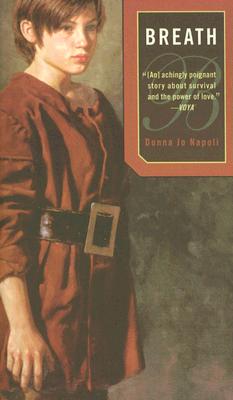
Review: Breath

Breath by Donna Jo Napoli

Published: 2003 by Simon Pulse
Word Count: 47, 453
Source: Paperback

My Grade: A+

Synopsis from GoodReads: Salz is a boy afflicted with cystic fibrosis -- though in the Middle Ages in Saxony no one can identify it as such. Instead he is an outcast, living with his unfeeling father and superstitious brothers in a hovel outside Hameln. His grandmother has kept Salz alive by having him avoid the mead and beer commonly drunk by all and by teaching him how to clear his lungs.
When the townsfolk of Hameln are affected by a mold that grows on the hops -- poisoning their mead and beer -- Salz is one of the few who are unaffected. The mold's effect is hallucinogenic, and soon Hameln is in the grips of a plague of madness, followed by a plague of rats. It is only Salz who can proclaim the truth -- although it might cost him his life.

Donna Jo Napoli has a talent for saying a lot in a small space. Her book is thin but the story is rich in character, setting, and action. There is texture and culture that brings the story to life, yet it is subtle enough that it does not overwhelm the simplistic style of the folktale. The book has a wide and advanced vocabulary, which may be frustrating for younger readers.

Napoli writes young adult novels based on classic fairy tales. This one is based on The Pied Piper of Hameln. I love her novels because she brings a sense of reality to the traditional stories. What these people were really feeling, thinking, experiencing. She places them in a concrete period of history and pulls the true human condition through the kiddy fluff that mainstream culture has often made these tales. These tales are passionate, heart-wrenching, wicked, cruel, gut-wrenching, and compelling all at once. Napoli shows us fairy tales’ truest potential and shines a light on why these stories exist in the first place.

I recently read on the author’s website that Breath is her favorite book she has written. I was pleasantly surprised by this information, thinking it serendipitous that I should come across it as I was reading Breath and not before, although I have read a number of her other fairy tale novelizations. She doesn’t offer a reason as to why this book is her favorite, and while it’s a great book, I wonder why, because I have found her other books to be just as good. Maybe it is the fairy tale she likes over the others she has written about. It can be hard to pin point why we prefer one fairy tale over another, can’t it? Like in my case, I love The Little Mermaid. Her novelization of this fairy tale is called Serena and I love it to bits. But why do I love it so much more than Beauty and the Beast, or Rapunzel, or Cinderella? It’s hard to say. But this is besides the point.

Still, this book is for people who appreciate stories at their barest essence. For people who appreciate a tale, a ‘story’ in the truest sense of the word. No gimmicks, no flashy action, no intrigue or convoluted plots. No protagonists who can kick butt while spewing snappy one-liners. No, this is a simple story. A story that shows us what storytelling used to be like. A story that shows us a simple tale can still captivate us. After reading some very flashy “hot” fantasy fiction that is popular now – which I enjoyed immensely, don’t get me wrong – this book acted almost as a detox. It brought be back to the books I read a lot as a kid.

Before I end this review I would like to talk about enchantment. Fairies enchant. It’s a simple fact. So I find myself relating this experience often in my writing (since I write about fairies). And yet, there are only so many times you can use the word ‘enchant.’ I am always looking for new ways to describe this experience of being enchanted or entranced, if you will. So I would like to point out the way Napoli does it in this story (although she does use the nefarious verb):

“The piper stands on the platform and looks out across the pandemonium, judging the situation. Then he takes out his pipe and plays. In an instant everyone goes silent. It’s as though we’ve heard the loudest thunderclap and seen the entire heaves fill with lightning. We are enchanted. And we’re moving. The music draws us all. We can’t stop ourselves.” (p. 242).

I also like how this instance of enchantment is brought on by music, as is often the case where fairies are concerned as well.

Find it on Amazon: Breath

Visit the author’s website: http://www.donnajonapoli.com/


Wednesday, July 14, 2010

The Magician’s Elephant by Kate Di Camillo 

Published:September 8th 2009 by Candlewick Press 
Word Count: 23,335
Source: Hardcover library book

My Grade: B

Synopsis from GoodReads: What if? Why not? Could it be?

When a fortuneteller's tent appears in the market square of the city of Baltese, orphan Peter Augustus Duchene knows the questions that he needs to ask: Does his sister still live? And if so, how can he find her? The fortuneteller's mysterious answer (an elephant! An elephant will lead him there!) sets off a chain of events so remarkable, so impossible, that you will hardly dare to believe it’s true. With atmospheric illustrations by fine artist Yoko Tanaka, here is a dreamlike and captivating tale that could only be narrated by Newbery Medalist Kate DiCamillo. In this timeless fable, she evokes the largest of themes — hope and belonging, desire and compassion — with the lightness of a magician’s touch.


This book’s poetic timbre and style remind me of an old tragic folk ballad. Its ultimate message is an uplifting one and all ends well, but the reader arrives here by first treading through somber themes. The world is broken, truth cannot be trusted, despairing in the unlucky fate of one’s circumstances – these are all ideas that pervade much of the story.

Some of the narrative seems a bit drastic, or at least over-dramatic, for a children’s book. Such as how the elephant becomes depressed after she is summoned to the town of Baltese by the magician:

“The world has become too cold and confusing and chaotic to bear, she [the elephant] stopped reminding herself of her name. She decided that she would like to die.’ (p 119)

Again this inclination, treated as simple truth, appears when Peter, the protagonist, visits the elephant for the first time:

“And Peter forgot about [his sister] Adele and his mother and the fortuneteller and the old soldier and his father and battlefields and lies and promises and predictions. He forgot about everything except for the terrible truth of what he saw, what he understood in the elephant’s eyes. She was heartbroken…The elephant must go home or she would surely die.” (p 129)

The theme of deliverance is strong. The trudging inhabitants of this sleepy solemn town know not what to put their faith in, so when the extraordinary happens, they cling to that, even though they know it is not truth: 

“And everyone, each person, had hopes and dreams, wishes for revenge, and desires for love. They stood together. They waited. And secretly, deep within their hearts, even though they knew it could not truly be so, they each expected that the mere sight of the elephant would somehow deliver them, would make their wishes and hopes and desires come true.” (pps 113–114)

Ideas of truth are also strong. The thought that truth might be subjective or that it is hard to gasp is set up in the first few pages of the book, when Peter asks the fortuneteller if his sister is alive, and she tells him something contrary to what his guardian, Lutz, has always told him. He walks home chanting to himself “he lies, she lies, he lies, she lies.” (p 3) and doesn’t know which to believe. This sentiment is repeated later in the book: “The truth is always changing.” (p 109) But while Peter may see the truth as something that is hard to pin down, he at least sees the world as full of possibilities. This is at odds with Gloria’s view of the world:

“‘How will the world change if we do not question it?’[asked the police officer] ‘The world cannot be changed.’ said [his wife] Gloria. ‘The world is what the world is and has forever been.’” (p 145)

But this is a self-defeating attitude. For the ones who seek to change, who challenge how things are, are the one who are remembered as innovators and great contributors to humanity.

"The world is broken, thought Peter, and it cannot be fixed." (p 150) All these themes combine to create a very dour mood to the book. But we are saved by the happy ending. The elephant goes home, the magician gets out of prison (he was put there for producing the elephant, which then landed on a woman and injured her), Peter and Adele are reunited, Peter no longer has to live with the insane militaristic Lutz, and Adele no longer has to live in the orphanage.

I’m giving this book a ‘B’ in my review because, though it has literary merit, it isn’t the most captivating book. It would be good for schools because there is a lot of subtext and meaning in the themes. I only scratched the surface in this review. The author calls it a story about love and magic, and it is that, but essentially it is a fable about believing in the impossible. 

Find it on Amazon: The Magician's Elephant 

Visit the author's website: http://www.katedicamillo.com/


Tuesday, July 13, 2010

Odd and the Frost Giants by Neil Gaiman

Published: 2008 by Bloomsbury
Word Count: 14,445
Source: Hardcover

My Grade: A

[WARNING: THIS REVIEW CONTAINS SPOILERS]

A short book written for the UK’s World Book Day; a great idea in my opinion. This is what Gaiman says about it on his website: [Odd and the Frost Giants] was written for something called World Book Day in the UK, where a bunch of authors write books for nothing, and publishers publish them for nothing, and they get sold for £1 each to kids who have been given £1 Book Tokens, and the whole thing exists purely in order to get kids reading. They describe it on their website as the biggest annual event promoting the enjoyment of books and reading.

Odd and his family live in the village of Midgard, where the cold of winter lingers on and spring does not come. “Winter hung there, like an invalid refusing to die.” (p 9) Odd rescues a bear with his arm stuck in a tree, and he invites the bear, along with his friends a fox and an eagle, into his father’s woodcutting hut. He soon learns that the bear is the god of thunder, Thor, the fox is the wily and cunning Loki, and the eagle is the All-father God, Odin.

It’s great that an author as well-known as Gaiman has chosen to get traditional folk tales out  there among the mainstream children’s chapter books. All too often folk tales are regulated to pictures books that, while beautiful, are hardly seen as substantial or something upon which an ancient and complex culture based its beliefs. So hurrah for Neil Gaiman and his subject matter. I am a big proponent of folklore and the cultural relevance it holds.

The best part of the book is the climax, of course, but the way in which Odd overcomes his foe the Frost Giant is unconventional from what we are used to seeing and reveals an aspect of Norse culture to the reader, which is that beauty is a powerful as brute strength and might.

Odd asks what the Giant what his brother wanted as payment for building the wall, and the Giant tells him, the Sun, the Moon, and Freya.

       “Why did he want those things?” Odd asked.

       “…and the giant whispered, in a voice like the howl of a winter wind, ‘Beauty.’”(p 82-83)
           
       “Odd said, ‘You came here for beauty, didn’t you? And you can’t go back empty-handed.’

       He reached into his jerkin and he took out the thing that he had carved. His father’s carving, which he had finished. It was his mother, as she had looked before he was born. It was the finest thing that Odd had ever made, and it was beautiful…

       The Frost Giant…smiled…and he said, ‘It is…remarkable. And lovely. Yes. I will take it back with me to Jotunheim, and it will brighten my hall.”’ (p 92-3)    

The Giant conquers Asgard, the home of the Gods, not for glory, or riches, or power, but for something much more unobtainable and fleeting: beauty. Likewise, Odd reclaims Asgard by offering the Giant something beautiful.

It is interesting to note that after the goddess Freya transforms the three Gods back to their true selves, she offers to mend Odd’s crippled leg, but admits that even she cannot fully heal it. The Norse Gods’ power has limits. They can even die. Without launching into a full analysis of Norse mythology, I’ll just say that what Freya does for Odd – healing him to some extent but not fully – seems to be in line with the Norse mythological canon. For if the Gods can be overcome by Giants and kicked out of their home, then their power must not be limitless.

Overall, this is a quaint and lovely retelling of iconic elements of Norse mythology.

Find it on Amazon: Odd and the Frost Giants 

Visit the author's website: www.neilgaiman.com

Books on this blog

  • City of Bones, Book One of The Mortal Instruments Series by Cassandra Clare
  • Eighth Grade Bites, The Chronicles of Vladimir Tod by Heather Brewer
  • Evermore by Alyson Noel
  • Fablehaven by Brandon Mull
  • Magyk, Book One of the Septimus Heap Series by Angie Sage
  • The Alchemyst: Secrets of the Immortal Nicholas Flamel by Michael Scott
  • The Bartimaeus Trilogy: The Amulet of Samarkand by Jonathan Stroud